

Relentless Marketing™: Why Your Property Needs a Campaign, Not an Advert
The property market might be moving slowly. That doesn’t mean your marketing should.
There is something happening in the property market that I believe is costing homeowners thousands of pounds and, in some cases, preventing perfectly saleable properties from selling at all.
It’s called marketing fatigue and it’s been around forever.
And while estate agents are quick to blame interest rates, cautious buyers, the economy or unrealistic asking prices for a lack of activity, there is another problem that deserves considerably more attention.
Their marketing has simply run out of steam.
Think about how most properties are marketed.
Most estate agent visit, take some photographs, prepare a description, produce a floorplan and upload everything to the property portals.
There might be a flurry of initial activity. Perhaps a social media post, an email to registered buyers and a few viewings.
Then what?
A week passes. Then another. Perhaps a month. Perhaps many.
The photographs remain the same. The description remains the same. The social media posts, if there are any, repeat the same ‘blahdy blah’ message.
Eventually, the only meaningful conversation between the agent and the seller is about reducing the asking price.
And the property, which might be a fantastic home for the right buyer, gradually disappears into the background.
This is precisely the problem our Relentless Marketing™ strategy was developed to overcome.
The dangerous assumption that once a property is advertised, it is being ‘marketed’.
One of my biggest frustrations with traditional estate agency is the assumption that placing a property ‘on the market’ is somehow the same as actively marketing it.
It isn’t.
Advertising is just one component part.
Marketing is giving people a compelling reason to notice it, consider it and, ultimately, act.
It has no fixed place, it is energy, movement, inertia.
In a fast-moving housing market, that distinction can become blurred. When there are plenty of buyers competing for relatively few properties, simply advertising a home in the right places can generate enquiries and offers.
But that is not the market we are operating in today.
Buyers have more choice. They are taking longer to make decisions. Affordability remains a significant consideration, and many are understandably reluctant to commit until they feel confident they are making the right purchase.
Properties can remain available for weeks or months. That means the process of finding and persuading the right buyer has become more demanding.
And yet, astonishingly, much of the estate agency industry continues to rely on a marketing approach designed for a market where buyers did most of the work themselves.
Put it online. Wait for enquiries. Reduce the price if nothing happens.
That’s not a marketing strategy.
Simply ‘waiting’ is not something I believe sellers should be paying an estate agent to do.
Your property hasn’t changed. So why have buyers stopped noticing it?
Imagine you’re searching for a new home.
You scroll through property websites and social media regularly, perhaps every day.
You see a house that catches your attention. You look at the photographs, read the details and decide it isn’t quite right for you.
Perhaps the asking price is a little higher than you wanted to pay. Perhaps you don’t immediately appreciate the layout, or you simply cannot picture how the property would work for your family.
A week later, you see it again.
Same photograph. Same headline. Same description.
You scroll past.
Another week passes.
Same photograph. Same headline. Same description.
You don’t even register it.
Eventually, you recognise the property instantly and dismiss it subconsciously.
Worse still, you may start wondering why nobody else has bought it.
This is how marketing fatigue turns into perceived property staleness.
And it is particularly dangerous in a slower market, because even a good property at a sensible price may need sustained exposure before the right buyer is ready to act.
The answer isn’t simply to advertise it more frequently. Nobody wants to see the same advert fifteen times.
The answer is to give people something different to think about. One property. Dozens of potential stories. Every home has multiple stories to tell.
Unfortunately, most property marketing attempts to tell all of them at once, in one description, supported by a collection of photographs.
Three bedrooms. Two bathrooms. Large garden. Double garage. Countryside views.
All perfectly useful information. But it tells us remarkably little about why somebody might actually want to live there.
Consider a detached family home with generous accommodation and a large garden.
One buyer might be attracted by the opportunity to work from home. Another might be looking for enough space to accommodate elderly parents or adult children. A third might love the idea of entertaining friends and family. Someone else might be searching for a property they can grow into over the next twenty years.
The house hasn’t changed.
But the reasons for buying it are completely different.
This is one of the fundamental principles behind Relentless Marketing™.
Rather than repeatedly presenting the same property in the same way, we continually explore different reasons why somebody might want to buy it.
We develop campaigns around individual features, lifestyle benefits, practical advantages and the aspirations of different buyer groups.
A kitchen might become the focus of one campaign. The garden might lead another. A video could demonstrate how the accommodation flows, while a separate piece of content explores the surrounding village, coastline or countryside.
Sometimes the most effective message isn’t about the property at all. It’s about what living there would allow somebody to do.
The important thing is that each campaign offers a fresh perspective and another opportunity to connect with someone who may previously have overlooked the home.
Because buyers don’t all respond to the same things. And they certainly don’t all respond at the same time.
Relentless Marketing™: a campaign, not just a launch and then oblivion.
We have developed Relentless Marketing™ as our signature approach to selling property in a market where sustained effort, creativity and adaptability matter more than ever.
The principle is straightforward.
We don’t believe the most important marketing happens during the first fortnight. We believe the quality of marketing throughout the entire selling period is what really separates an effective estate agent from an ineffective one.
Of course, the launch matters. Massively.
But what happens if the property doesn’t sell in the first two weeks?
Or the first month?
That’s where a proper marketing strategy should begin demonstrating its value.
Our approach involves developing a structured sequence of campaigns, each with a different focus, message or target audience.
We use a combination of property portals, our own websites, social media, video, targeted advertising, direct communication with buyers over the phone/messaging/email, personal networks, email marketing, direct mail and, where appropriate, editorial and public relations opportunities.
Not every property requires every channel, and not every campaign is designed to achieve the same thing. Every campaign is tailored to the property and who its most likely buyer could be.
Some are intended to reach entirely new audiences.
Others are designed to re-engage buyers who have already seen the property but haven’t taken the next step.
Some highlight an overlooked benefit.
Others address a specific objection or respond to changes in the market.
We also use carefully planned Open House opportunities, by appointment, where appropriate to concentrate interest and give potential buyers a reason and the urgency to make a decision.
Each week should offer something meaningful to say, something different to show or a new audience to reach.
And because the campaigns are planned rather than improvised, we can maintain momentum without resorting to repetitive, increasingly desperate advertising.
Fresh marketing creates fresh conversations.
It gives us new reasons to contact buyers, approach potential prospects, engage our professional networks and encourage people to reconsider a property.
Instead of asking whether someone has seen a house that has been available for three months, we can introduce a new angle, a new opportunity or a meaningful change in its positioning. That is a very different conversation.
Relentless Marketing™ in action: Summit View, Lynton — £650,000

A recent example of this approach is Summit View in Lynton, marketed through Match Property.
A distinctive detached home with exceptional panoramic sea and countryside views, flexible accommodation and a location that offers a wonderful combination of coast, countryside and village life.
Summit View had already experienced the difficulties that can arise in a slower market, including a previous sale falling through. It would have been easy to allow the property to drift along, relying on its existing advertising and hoping another buyer would eventually appear.
Instead, we worked with the owners to continually review both the marketing and the property’s position within the market. The asking price was meaningfully repositioned, rather than relying on insignificant reductions unlikely to change buyer behaviour.
Alongside this, our 10 week autumn marketing campaign continued to explore different aspects of the property, its spectacular outlook, its flexibility and the lifestyle available to prospective purchasers.
We didn’t simply keep repeating the same advert.
We gave buyers fresh reasons to look.
The result was renewed activity, six further viewings, two offers and ultimately a sale agreed at £650,000.
Was that entirely down to marketing?
Pricing played a crucial role, as did the owners’ willingness to respond constructively to market conditions.
But that is precisely the point.
Successful property marketing isn’t about choosing between an attractive asking price and an effective promotional campaign.
It’s about making both work together.
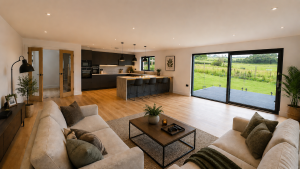
Lincombe Lodge (above): a £1.25 million buyer found through LinkedIn.
Our approach isn’t confined to the mainstream housing market.
And, ultimately, the buyer who agreed to purchase Lincombe Lodge for £1.25 million came through LinkedIn.
Think about that for a moment.
A £1.25 million property sale generated through a platform many estate agents still regard as somewhere to post company announcements and congratulate each other on their achievements.
The buyer wasn’t delivered by endlessly recycling a Rightmove advert.
They were reached through a broader, sustained marketing strategy that recognised the importance of being visible in places where potential buyers spend their time, even when they aren’t actively searching for property.
That is why I believe property marketing must extend well beyond the conventional portals.
And it is why our approach is designed to reach buyers rather than simply wait for buyers to find us.
The market may be static. Your property marketing must remain dynamic.
There is a psychological dimension to all of this that I think the industry frequently overlooks.
A property that has been available for several months can begin to feel old.
Not physically old.
Commercially old.
Buyers see the same listing, the same photographs and the same description, and assume nothing has changed.
They begin to wonder why the property hasn’t sold.
The longer that continues, the harder it can become to generate excitement.
But a property can have been on the market for several months and still be presented in a vibrant, relevant and compelling way.
New content can introduce it to new buyers.
A different lifestyle message can resonate with someone who previously dismissed it.
A meaningful price adjustment can change its position against competing properties.
A fresh video can help a buyer appreciate something that static photographs failed to communicate.
A targeted campaign can reach someone who wasn’t even considering moving when the property first came onto the market.
And a well-timed conversation can turn passive interest into an appointment.
Each creates an opportunity.
And in a slower market, opportunities matter enormously. The worst thing that can happen to a property isn’t necessarily that it takes several months to sell. It’s that nothing meaningful happens during those months.
No fresh thinking.
No new campaigns.
No constructive conversations.
No meaningful review of the asking price.
Just a property sitting online, becoming increasingly familiar and increasingly easy to ignore.
That is exactly what Relentless Marketing™ is designed to prevent.
What should you expect from your estate agent?
If you’re selling your home, I think you should be asking some fairly straightforward questions.
What is your agent doing this week to attract new buyers?
How is the marketing different from what they were doing last month?
What have they learned from the enquiries and viewings so far?
How does your asking price compare with the properties buyers are considering as alternatives?
What happens next if the current approach isn’t generating results?
And can they demonstrate a clear strategy beyond simply keeping the property advertised?
These aren’t unreasonable demands. They’re fundamental questions that any professional estate agent should be able to answer.
I also believe sellers deserve an agent whose enthusiasm doesn’t disappear once the initial excitement of winning the instruction has worn off. That initial burst of energy is easy. The real test is what happens in week six, week ten or month four.
Is your agent still looking for new opportunities?
Still challenging their own assumptions?
Still finding fresh ways to present your home?
Still actively trying to create a sale?
Or have you become another listing on a website, waiting for the next conversation about reducing the price?
Because there is a considerable difference between an estate agent who has your property for sale and one who is actively trying to sell it.
Relentless doesn’t mean desperate. It means determined.
It means maintaining the same determination to sell a property in month four as we had on day one. It means accepting that a marketing campaign which worked brilliantly for one property might not be right for another. It means having the confidence to tell sellers when their price needs reconsidering, and the creativity to find new opportunities when the marketing needs improving. It means recognising that every home has a story worth telling, and that different buyers may need to hear different parts of that story before they recognise its appeal.
Most importantly, it means taking responsibility for the process.
We cannot control interest rates, the wider economy or when an individual buyer decides they are ready to move.
But we can control the quality of our marketing, the effort we put into reaching buyers, the advice we give our clients and how quickly we respond to changing circumstances.
Those are the things we should be judged on.
Is your property becoming invisible? If you’re thinking of selling your home, don’t just ask an estate agent where they will advertise it.
Ask what they intend to do after the initial launch.
Ask how they will maintain interest if the property hasn’t sold after four, eight or twelve weeks.
Ask how they will monitor the market and adapt their strategy.
And if your home is already on the market, but the enquiries have slowed, the viewings have dried up or the enthusiasm of your estate agent seems to have disappeared, it may be time for a fresh perspective.
Because your property deserves more than an advert. It deserves a campaign.
And while the property market might be moving slowly, there is absolutely no reason why your marketing should.
I’m Nic Chbat, Director of Match Property and Unique and Distinctive Homes in Barnstaple, and for the past 20 years I’ve helped North Devon homeowners make sense of the market, attract the right buyers and achieve the best possible result from their sale.

Book and advice meeting with me HERE
Call for a chat 01271 410108
Email your questions to nic@matchproperty.co.uk